


teel pipes are long, hollow tubes that are used for a variety of purposes. They are produced by two distinct methods which result in either a welded or seamless pipe. In both methods, raw steel is first cast into a more workable starting form. It is then made into a pipe by stretching the steel out into a seamless tube or forcing the edges together and sealing them with a weld. The first methods for producing steel pipe were introduced in the early 1800s, and they have steadily evolved into the modern processes we use today. Each year, millions of tons of steel pipe are produced. Its versatility makes it the most often used product produced by the steel industry.
Steel pipes are found in a variety of places. Since they are strong, they are used underground for transporting water and gas throughout cities and towns. They are also employed in construction to protect electrical wires. While steel pipes are strong, they can also be lightweight. This makes them perfect for use in bicycle frame manufacture. Other places they find utility is in automobiles, refrigeration units, heating and plumbing systems, flagpoles, street lamps, and medicine to name a few.
History
People have used pipes for thousands of years. Perhaps the first use was by ancient agriculturalists who diverted water from streams and rivers into their fields. Archeological evidence suggests that the Chinese used reed pipe for transporting water to desired locations as early as 2000 B.C. Clay tubes that were used by other ancient civilizations have been discovered. During the first century A.D. , the first lead pipes were constructed in Europe. In tropical countries, bamboo tubes were used to transport water. Colonial Americans used wood for a similar purpose. In 1652, the first waterworks was made in Boston using hollow logs.
Development of the modern day welded steel pipe can be traced back to the early 1800s. In 1815, William Murdock invented a coal burning lamp system. To fit the entire city of London with these lights, Murdock joined together the barrels from discarded muskets. He used this continuous pipeline to transport the coal gas. When his lighting system proved successful a greater demand was created for long metal tubes. To produce enough tubes to meet this demand, a variety of inventors set to work on developing new pipe making processes.
An early notable method for producing metal tubes quickly and inexpensively was patented by James Russell in 1824. In his method, tubes were created by joining together opposite edges of a flat iron strip. The metal was first heated until it was malleable. Using a drop hammer, the edges folded together and welded. The pipe was finished by passing it through a groove and rolling mill.
Russell's method was not used long because in the next year, Comelius Whitehouse developed a better method for making metal tubes. This process, called the butt-weld process is the basis for our current pipe-making procedures. In his method, thin sheets of iron were heated and drawn through a cone-shaped opening. As the metal went through the opening, its edges curled up and created a pipe shape. The two ends were welded together to finish the pipe. The first manufacturing plant to use
this process in the United States was opened in 1832 in Philadelphia.
Gradually, improvements were made in the Whitehouse method. One of the most important innovations was introduced by John Moon in 1911. He suggested the continuous process method in which a manufacturing plant could produce pipe in an unending stream. He built machinery for this specific purpose and many pipe manufacturing facilities adopted it.
While the welded tube processes were being developed, a need for seamless metal pipes arouse. Seamless pipes are those which do not have a welded seam. They were first made by drilling a hole through the center of a solid cylinder. This method was developed during the late 1800s. These types of pipes were perfect for bicycle frames because they have thin walls, are lightweight but are strong. In 1895, the first plant to produce seamless tubes was built. As bicycle manufacturing gave way to auto manufacturing, seamless tubes were still needed for gasoline and oil lines. This demand was made even greater as larger oil deposits were found.
1840 yil boshida temirchilar choksiz naychalarni ishlab chiqarishlari mumkin edi. Bir usulda qattiq metall, dumaloq ignabargli teshik qazilgan. Keyin ignabargli isitilib, uni qatorga tortib, uni quvur hosil qilish uchun cho'zdi. Ushbu usul samarasiz edi, chunki markazda teshikni burg'ulash qiyin edi. Natijada notekis trubka paydo bo'lib, uning bir tomoni ikkinchisidan qalinroq bo'lgan. 1888 yilda takomillashtirilgan usul patentga sazovor bo'ldi. Ushbu jarayonda qattiq g'isht olovga chidamli g'isht yadrosiga o'ralgan. Sovutgandan so'ng, o'rtada teshik qoldirib, g'isht olib tashlandi. O'shandan beri yangi rollarda ushbu usullar almashtirildi.
Dizayn
Ikki xil po'lat quvur bor, biri choksiz, ikkinchisi uzunligi bo'ylab bitta payvandlangan tikuvga ega. Ikkalasining har xil foydalanishi bor. Choksiz naychalar odatda engilroq bo'lib, devorlari ingichka bo'ladi. Ular velosipedda va suyuqlikni tashishda ishlatiladi. To'qilgan naychalar og'irroq va qattiqroq. Yaxshiroq mustahkamlik va odatda tekisroq bo'ladi. Ular gaz tashish, elektr o'tkazgich va sanitariya-tesisat kabi narsalar uchun ishlatiladi. Odatda, ular quvur yuqori darajadagi stress ostida bo'lmagan hollarda qo'llaniladi.
Certain pipe characteristics can be controlled during production. For example, the diameter of the pipe is often modified depending how it will be used. The diameter can range from tiny pipes used to make hypodermic needles, to large pipes used to transport gas throughout a city. The wall thickness of the pipe can also be controlled. Often the type of steel will also have an impact on pipe's the strength and flexibility. Other controllable characteristics include length, coating material, and end finish.
Raw Materials
The primary raw material in pipe production is steel. Steel is made up of primarily iron. Other metals that may be present in the alloy include aluminum, manganese, titanium, tungsten, vanadium, and zirconium. Some finishing materials are sometimes used during production. For example, paint may be
used if the pipe is coated. Typically, a light amount of oil is applied to steel pipes at the end of the production line. This helps protect the pipe. While it is not actually a part of the finished product, sulfuric acid is used in one manufacturing step to clean the pipe.
The Manufacturing
Process
Steel pipes are made by two different processes. The overall production method for both processes involves three steps. First, raw steel is converted into a more workable form. Next, the pipe is formed on a continuous or semicontinuous production line. Finally, the pipe is cut and modified to meet the customer's needs.
Ingot production
1 Molten steel is made by melting iron ore and coke (a carbon-rich substance that results when coal is heated in the absence of air) in a furnace, then removing most of the carbon by blasting oxygen into the liquid. The molten steel is then poured into large, thick-walled iron molds, where it cools into ingots.
2 In order to form flat products such as plates and sheets, or long products such as bars and rods, ingots are shaped between large rollers under enormous pressure.
Producing blooms and slabs
3 Gullab-yashnashi uchun ingot qoqilgan po'latdan yasalgan roliklar orqali uzatiladi. Ushbu turdagi roliklar "ikki baland tegirmon" deb nomlanadi. Ba'zi hollarda uchta rolik ishlatiladi. Rulonlar o'rnatilgan bo'lib, ularning yivlari bir-biriga mos keladi va ular qarama-qarshi yo'nalishda harakatlanadi. Ushbu harakat po'latni siqib, ingichka, uzunroq bo'laklarga mixlashiga olib keladi. Rulonlar inson operatori tomonidan o'zgartirilganda, po'lat uni ingichka va uzunroq qilish orqali orqaga tortiladi. Ushbu jarayon po'lat istalgan shaklga erishmaguncha takrorlanadi. Ushbu jarayon davomida manipulyator deb nomlangan mashinalar po'latni burishadi, shunda har ikki tomon teng ravishda qayta ishlanadi.
4 Shuningdek, ingot gullarni hosil qilish jarayoniga o'xshash jarayonda plitalarga o'ralishi mumkin. Po'lat uni cho'zilgan bir-biridan iborat roliklar orqali o'tadi. Shu bilan birga, plitalarning kengligini nazorat qilish uchun yon tomonga o'rnatilgan rulolar mavjud. Po'lat kerakli shaklga ega bo'lganda, notekis uchlari kesiladi va plitalar yoki gullar qisqa qismlarga kesiladi.
Keyinchalik qayta ishlash
5 Odatda gullar quvurlarga kiritilishidan oldin qayta ishlanadi. Gullar ignabarglarga aylantiriladi, ularni uzunroq va torroq qilib qo'yadigan ko'proq aylantiruvchi moslamalar orqali amalga oshiriladi. Blyashka uchadigan makaslar deb nomlanadigan asboblar bilan kesilgan. Bu sinxron qaychi juftligi, ular harakatlanuvchi ignabargli bilan birga chopishadi va uni kesib tashlashadi. Bu ishlab chiqarish jarayonini to'xtatmasdan samarali kesish imkonini beradi. Ushbu ignabargli narsalar tikilgan va oxir-oqibat choksiz quvurga aylanadi.
6 Slabs are also reworked. To make them malleable, they are first heated to 2,200° F (1,204° C). This causes an oxide coating to form on the surface of the slab. This coating is broken off with a scale breaker and high pressure water spray. The slabs are then sent through a series of rollers on a hot mill and made into thin narrow strips of steel called skelp. This mill can be as long as a half mile. As the slabs pass through the rollers, they become thinner and longer. In the course of about three minutes a single slab can be converted from a 6 in (15.2 cm) thick piece of steel to a thin steel ribbon that can be a quarter mile long.
7 After stretching, the steel is pickled. This process involves running it through a series of tanks that contain sulfuric acid to clean the metal. To finish, it is rinsed with cold and hot water, dried and then rolled up on large spools and packaged for transport to a pipe making facility.
Pipe making
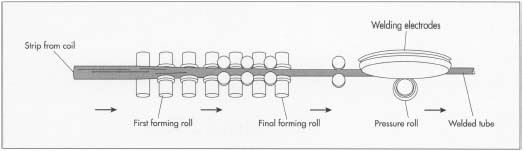
8 Both skelp and billets are used to make pipes. Skelp is made into welded pipe. It is first placed on an unwinding machine. As the spool of steel is unwound, it is heated. The steel is then passed through a series of grooved rollers. As it passes by, the rollers cause the edges of the skelp to curl together. This forms an unwelded pipe.
9 The steel next passes by welding electrodes. These devices seal the two ends of the pipe together. The welded seam is then passed through a high pressure roller which helps create a tight weld. The pipe is then cut to a desired length and stacked for further processing. Welded steel pipe is a continuous process and depending on the size of the pipe, it can be made as fast as 1,100 ft (335.3 m) per minute.
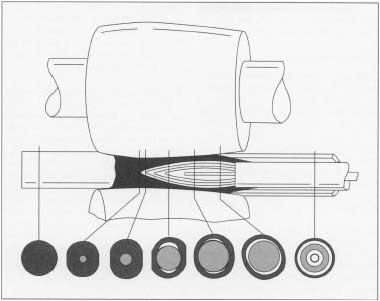
10 When seamless pipe is needed, square billets are used for production. They are heated and molded to form a cylinder shape, also called a round. The round is then put in a furnace where it is heated white-hot. The heated round is then rolled with great pressure. This high pressure rolling causes the billet to stretch out and a hole to form in the center. Since this hole is irregularly shaped, a bullet shaped piercer point is pushed through the middle of the billet as it is being rolled. After the piercing stage, the pipe may still be of irregular thickness and shape. To correct this it is passed through another series of rolling mills.
Final processing
11 Ikkala quvur ham tayyor bo'lgandan so'ng, ularni tekislash mashinasi orqali o'rnatish mumkin. Ikkita yoki undan ortiq trubka ulanishi uchun ular bo'g'inlar bilan ham o'rnatilishi mumkin. Kichikroq diametrli quvurlar uchun eng keng tarqalgan birikma - bu ipning uchi bilan kesilgan tor yivlar. Quvurlar ham o'lchash mashinasi orqali yuboriladi. Ushbu ma'lumot boshqa sifat nazorati ma'lumotlari bilan birga trubkada avtomatik ravishda stencil qilinadi. Keyin quvur himoya yog'ining engil qoplamasi bilan püskürtülür. Ko'pincha quvur zang bo'lishiga yo'l qo'ymaslik uchun ishlov beriladi. Bu uni galvanizatsiyalash yoki sink bilan qoplash orqali amalga oshiriladi. Quvurni ishlatishga qarab, boshqa bo'yoqlar yoki qoplamalar ishlatilishi mumkin.
Sifat nazorati
Tayyor po'lat quvurning texnik xususiyatlarga mos kelishini ta'minlash uchun turli xil choralar ko'riladi. Masalan, po'latning qalinligini tartibga solish uchun rentgen o'lchagichlar qo'llaniladi. O'lchov asboblari ikkita rentgen nurlari yordamida ishlaydi. Bir nur ma'lum qalinlikdagi po'latga yo'naltirilgan. Ikkinchisi ishlab chiqarish liniyasida po'latdan o'tishga qaratilgan. Agar ikkita nur o'rtasida tafovut bo'lsa, o'lchash moslamasi avtomatik ravishda o'lchovni o'zgartirish uchun qo'zg'atadi.
Quvurlar, shuningdek, jarayon oxirida nuqsonlar uchun tekshiriladi. Quvurni sinashning bitta usuli - bu maxsus mashinadan foydalanish. Ushbu mashina quvurni suv bilan to'ldiradi va keyin uning ushlab turilishini ko'rish uchun bosimni oshiradi. Buzuq quvurlar hurda uchun qaytariladi.


